

Ask a maintenance manager what the risky part of a kiln outage is and most will say the reline. Ask them where outages actually slip and the honest answer is usually earlier than that: the strip out.
Refractory removal sits right at the front of the critical path. The reline crew cannot start until the old lining is out and the shell is clean, and every hour lost at that end is an hour the plant is not making product. On a cement kiln that hour is expensive enough that it changes how the whole job should be planned.
Why strip out runs late
Three things account for most of it.
Waiting for temperature. Traditional hand crews cannot enter until the shell has cooled to a workable range. That wait is dead time, and it is often longer than the plan assumed because cool down curves are estimated rather than measured.
Underestimating the lining. Records say one thing, the kiln says another. Castable that has been through repeated thermal cycling behaves nothing like the datasheet. Patch repairs from previous outages sit in unexpected places. If the price and the program were built on the drawing rather than the reality, the schedule moves.
Debris logistics. This is the quiet one. A crew can break material faster than it can be carried out, and the moment the working face is blocked the whole operation drops to the speed of the wheelbarrow. Removal capacity has to be planned to match breaking capacity, not bolted on afterwards.
Where the time is actually won
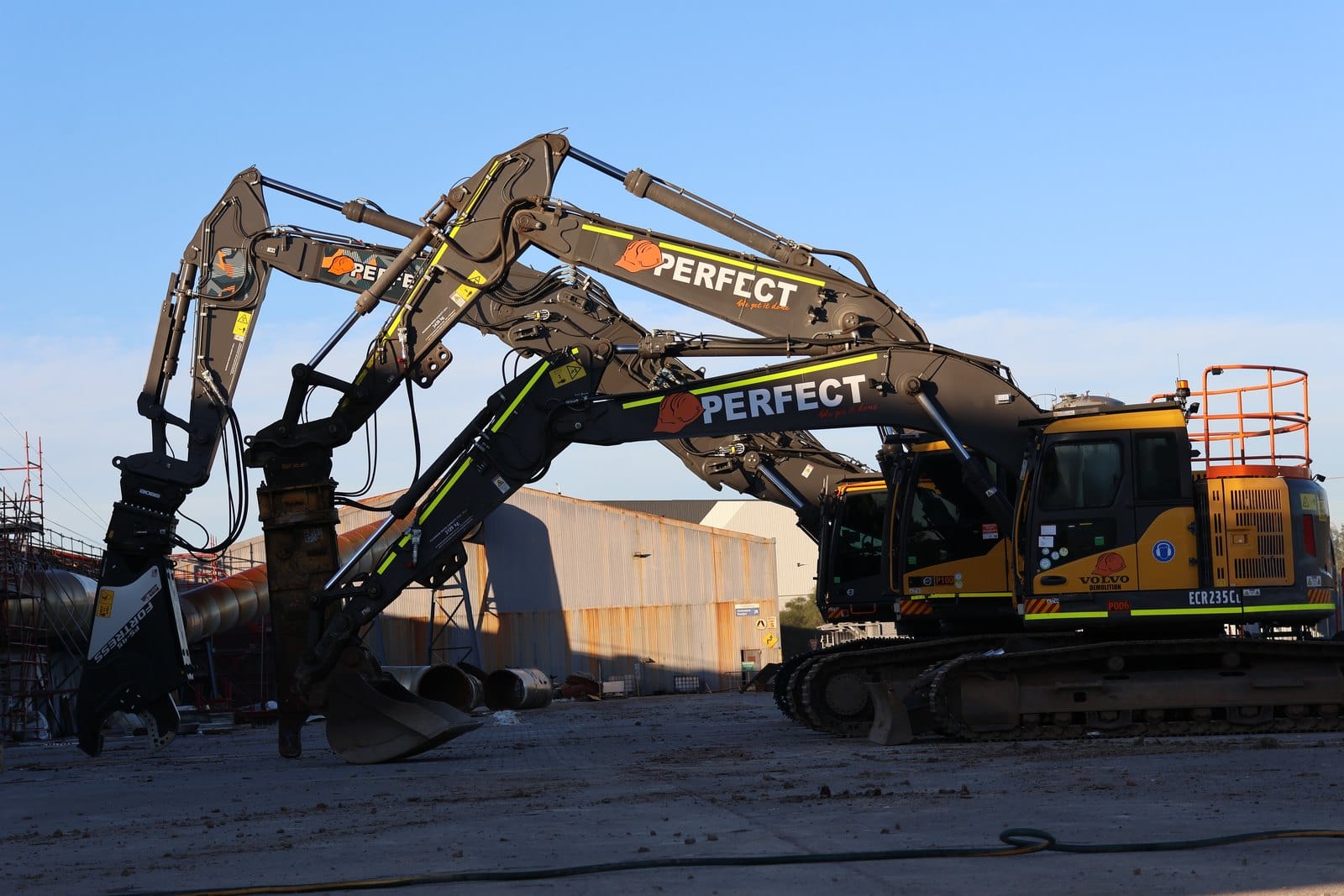
Start earlier in the cool down. Remote demolition machines can be tracked in while conditions are still marginal for people. The operator stands well back with a control box, so the constraint becomes the machine and the structure rather than what a person can tolerate. On a tight outage this alone can return a day or more.
Break harder. A compact remote machine with a hydraulic hammer removes brick and dense castable at a rate that hand tools and light breakers cannot approach. It stabilises on outriggers so the energy goes into the lining instead of shaking the operator.
Know the material before you mobilise. Sampling and a proper condition assessment ahead of the outage lets the method be chosen once, rather than adjusted on day two when the first section refuses to come out. Where older linings may contain refractory ceramic fibre or other hazardous material, that assessment is a safety requirement as well as a planning one.
Agree the handover standard in writing. How clean does the shell need to be before the reline contractor will accept it? Anchors cut back to what tolerance? Getting that agreed before the outage removes the argument that otherwise happens at the worst possible moment, with two crews standing around.


The safety case that also happens to be faster
Refractory removal has always been one of the more dangerous jobs in industrial maintenance. People work inside a confined cylindrical space, in heat, under material that is by definition unstable because it is being deliberately broken loose above their heads.
Taking the operator out of that zone is the right thing to do regardless of program. The useful part is that the safest method is usually also the quickest one, which is a rare alignment in construction.
A practical planning sequence
- Four to six weeks out: confirm lining type, thickness and known problem areas with the maintenance team.
- Sample where records are unclear, and treat unknown linings as hazardous until testing says otherwise.
- Agree access, lifting and isolation requirements with the shutdown coordinator, not just the maintenance planner.
- Set the debris route and removal capacity to match the intended breaking rate.
- Write down the shell handover standard and get the reline contractor to sign up to it.
- Build a contingency into the sequence rather than the end date, because refractory always has one surprise in it.
None of this is complicated. It is just work that has to happen before the outage rather than during it, and outages that go well are almost always the ones where somebody did that work early.
Talk to someone who has run these jobs
If you have one of these coming up, the earliest conversation is the cheapest one. Call 02 8015 6345 or read more about our kiln, furnace and refractory removal.


 Perfect Contracting acknowledges the Aboriginal and Torres Strait Islander people as Traditional Custodians of the country on which we live and work. We pay our respects to the Traditional Custodians and Elders past, present and future, and honour their connection to the land and ongoing contribution to society.